
As many as 31 mainboard IPOs raised a cumulative Rs 26,272 crore in this period, according to Prime Database. During the April-September 2007 bull run, 48 IPOs totalling Rs 21,243 crore were launched. The number of deals in H1FY24 was 2.2 times that of the same period of the last fiscal year, but the amount raised was 26 per cent lower.

Rates India 'BBB-' with a negative outlook.

Eminent economist Arvind Panagariya has said India is on the cusp of returning to a high growth trajectory and voiced confidence that the country will become the world's third-largest economy by 2027-28. Currently, India is the fifth largest economy "so it's another five years.We are already in (the year) 2023. "So 2027-28, India should be the third-largest economy," Panagariya, Columbia University Professor and former Vice Chairman of NITI Aayog, told PTI in an interview in New York.
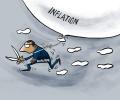
'If all goes well, we may well hit or even surpass the forecast growth rate.'

In a memorable year for the equity market, Dalal Street investors added a whopping Rs 81.90 lakh crore to their wealth in 2023 as a raft of positive factors powered a stellar rally in stocks. Experts said India's strong macroeconomic fundamentals, political stability owing to the BJP's success in recent elections in three significant states, optimistic corporate earnings outlook, signals from the US Federal Reserve about three prospective rate cuts next year and heavy retail investors participation played a major role in fuelling the stock market rally in 2023. In the year 2023, the 30-share BSE Sensex jumped 11,399.52 points or 18.73 per cent.

Let's delve into the world of IPL 2024 and meet the captains who are ready to leave their mark on cricket's biggest stage.

'While every year presents new challenges, it also provides opportunities for better growth and performance.'

S&P Global Ratings on Thursday cut India's growth forecast for the current fiscal to 9.5 per cent, from 11 per cent earlier, and warned of risk to the outlook from further waves of COVID pandemic. The agency lowered the growth outlook saying that a severe second COVID-19 outbreak in April and May led to lockdowns imposed by states and sharp contraction in economic activity. "We forecast growth of 9.5 per cent this fiscal year from our March forecast of 11 per cent," S&P said.

A lot more people should buy stocks, they should be guided far more by fundamentals and their expectation of returns should be far more modest

Since December 2018, monetary policy has been eased substantially by RBI with policy rates being cut by 75 bps and policy outlook being changed to 'accommodative'.

rediffGURU Ramalingam Kalirajan answers your personal finance queries.

The benchmark National Stock Exchange Nifty has rallied 4 per cent, or 750 points, from this month's low to end at 19,732 on week ending November 17. Technical analysts say the market could consolidate around the current levels as it is nearing the resistance zone. "The near-term uptrend status of the market remains intact, but there is a possibility of some more consolidation or minor weakness for the Nifty in the next one to two sessions.

RBI said inflation in the second half of the current fiscal is projected at 2.7-3.2%. It retained its GDP forecast for the current fiscal at 7.4%

Tata Motors surpassed Maruti Suzuki (India) (MSIL) to become the most-valuable automobile company, in terms of market capitalisation (mcap), after a gap of seven years. With this, the company's stock hit a new high on the BSE on Tuesday (January 30). The combined mcap of Tata Motors (Rs 285.51 crore) and Tata Motors DVR (Rs 29,119 crore) stood at Rs 3.146 trillion.

The chemicals sector's recovery could be delayed until FY25 if the current trends of weak demand and flat pricing continue. Following a subdued September quarter, the revenue and profit performance of listed chemicals companies are anticipated to fall short of initial expectations of an improvement. Despite some price stability, the demand trajectory remains uncertain.

India's growth in the last three financial years has averaged just 1.9%. It is natural to project rapid growth from this low base. Crucial to that would be the assumption that the economy has suffered no lasting damage from the pandemic, observes T N Ninan.

The Reserve Bank of India, for the second straight time, on Thursday kept its key policy rate unchanged at 5.15 per cent, maintaining its accommodative policy stance as long as it was necessary to revive growth. The central bank retained GDP growth at 5 per cent for 2019-20 and pegged it at 6 per cent for the next fiscal.

In South Asia, the poverty would fall to 13.5 per cent in 2015.

The International Monetary Fund (IMF) has said India and China will account for half of the global economic growth in 2023, as the multilateral agency retained its growth forecast for Asia's third-largest economy for 2023-24 (FY24). "India remains a bright spot. Together with China, it will account for half of global growth this year, versus just a tenth for the US and euro area combined," the IMF said in its latest update to the biannual World Economic Outlook. Growth in India is set to decline from 6.8 per cent in 2022 (FY23) to 6.1 per cent in 2023 (FY24) before picking up to 6.8 per cent in 2024 (FY25), the global lender said while citing "resilient domestic demand despite external headwinds".

The fast-moving consumer goods (FMCG) sector has underperformed the Nifty over the past year as its 20 per cent return is trumped by 29 per cent of the benchmark index. The FMCG index saw a 2.2 per cent drop in the last session, while the Nifty lost 1 per cent. FMCG is seen as a defensive segment. The demand for staples like personal care products, groceries and snacks tend to be stable. FMCG companies are consistent dividend-payers.

India has been relatively insulated from the severe headwinds in the West. However, with a third of the global economy expected to slip into recession in calendar year 2023, the impact will strongly be felt on India's exports and trade economy, leading economists said in a panel discussion at the Business Standard BFSI Insight Summit in Mumbai on Wednesday. The panel comprised former Reserve Bank of India executive director and former Monetary Policy Committee member Mridul Saggar, State Bank of India Chief Economic Advisor Soumya Kanti Ghosh, Citibank India Chief Economist Samiran Chakraborty, ICRA Chief Economist Aditi Nayar, and IndusInd Bank Chief Economist Gaurav Kapoor. The topic of the panel discussion was No recession in sight: Is India decoupled from developed economies?

India and the US on Friday expressed concern over high inflation which is being driven by external factors and has become a challenge for both the nations. Speaking at the US-India Businesses and Investment Opportunities, Finance Minister Nirmala Sitharaman said in India the inflation challenges are prompted more by external factors. "So while the number today is in a manageable range, the challenges are largely due to the import of crude.
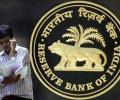
The Reserve Bank on Wednesday hiked key benchmark policy rate by 25 basis points to 6.5 per cent, citing sticky core inflation.
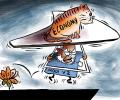
India's growth outlook has weakened sharply this year, with a crunch that started with the non-banking finance institutions spreading to retail businesses, car-makers, home sales and heavy industries.

Mayaram said the concerns over the pace of implementing economic reforms were "overstated".

'To the believers of crypto regulations, I have only one question to ask, how will you regulate it?'

Indian equity markets had a good run in the first half of calendar year 2023 (CY23), with the S&P BSE Sensex and the National Stock Exchange Nifty50 hitting fresh 52-week highs. While the Sensex scaled up to a peak 64,718, the Nifty50 hit Mt 19,189. As the markets now prepare to enter the second half (H2) of CY23, all eyes are on global central banks, especially the US Federal Reserve, as to when they will pause and pivot as regards their interest-rate cycle.

'The revenue projection arises out of all sectors doing well and the formalisation of the economy helps in making sure the tax domain gets widened.'

Since its results for the first quarter of the 2023-24 financial year (Q1FY24) earlier this month, the stock of auto component major Bharat Forge is up nearly 15 per cent and hit its all-time high in the process. The recent gains have extended the returns over the last three months to over 34 per cent. After a strong Q1 performance which beat expectations, brokerages had revised their earnings estimates upwards to factor in the improved outlook.

'India has the potential to do a lot more to take advantage of the time today where we stand to gain, geopolitically and in terms of market attractiveness.'

'There is no reason why we should break this business up.'
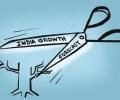
Moody's Investors Service on Thursday slashed India's economic growth projection for 2022 to 7.7 per cent, saying that rising interest rates, uneven monsoon, and slowing global growth will dampen economic momentum on a sequential basis.

For the week, the Sensex climbed 28.24 points, or 0.08 per cent, while the Nifty shed 38.15 points, or 0.36 per cent.

Premium valuations era started in 2006 and went hand in hand with decline in the US interest rates

Automobile retail sales in India rose by 9 per cent in August aided by sales growth in all segments, including passenger vehicles and two wheelers, dealers' body FADA said on Tuesday. The total retail sales across segments rose to 18,18,647 units last month, up 9 per cent, from 16,74,162 units in August 2022. Passenger vehicle registrations increased by 7 per cent to 315,153 units last month from 295,842 units in August 2022.
Yes Bank was the top gainer in the Sensex pack rising 5.80 per cent, followed by Tata Motors, ICICI Bank, IndusInd Bank, Axis Bank, Kotak Bank and Tata Steel.
Draft Red Herring Prospectus (DRHP) filing continued to be robust in October, signifying the optimism in the initial public offer (IPO) market despite the recent turbulence in equities. In October, 17 companies filed their offer documents for IPOs. The rush in filings has made August-October 2023 the best three-month period for DRHP filings since July-September 2021.

Fitch Ratings has revised India's GDP forecast to minus 9.4 per cent in the current fiscal year from a previously projected contraction of 10.5 per cent after the economy staged a sharper rebound in the second quarter. In its Global Economic Outlook, Fitch said the coronavirus-induced recession inflicted severe economic scarring and the country needs to repair balance sheets and increase caution about long-term planning. "We now expect GDP to contract 9.4 per cent in the fiscal year to end March 2021 (plus 1.1 percentage point) followed by plus 11 per cent growth (unchanged) and plus 6.3 per cent growth in the following years," the rating agency said.

Stating that an economic recession gripped global economy following the lockdowns due to COVID-19 pandemic, Fitch Ratings on Friday said the initial disruptions to regional manufacturing supply chains in China have now broadened to include local discretionary spending and exports.

The Indian services sector growth touched a six-month high in December, supported by a robust intake of new work and favourable market conditions, a monthly survey said on Wednesday. The seasonally adjusted S&P Global India Services PMI Business Activity Index rose from 56.4 in November to 58.5 in December, highlighting the strongest rate of expansion since mid-2022. For the 17th straight month, the headline figure was above the neutral 50 threshold.
 © 2026 Rediff.com - Advertise with us - Disclaimer - Privacy Policy - Sitemap - Feedback - About us - Terms of use - Grievances